Real pronunciation feedback.
Most apps grade what they think you said. We grade what you actually said.
Published: May 6, 2026
Why most apps say your pronunciation is perfect
Predictive speech recognition
If you've spent any time with a Korean pronunciation app, you've probably realized it usually just tells you your pronunciation is perfect and doesn't actually give you real feedback.
Why is this the case? Most Korean apps on the market today use predictive speech recognition when evaluating your pronunciation. What that effectively means is that the app is grading what it thinks you said, not what you actually said.
So as long as what you produced was reasonably close, and didn't sound more like some other word than the word you were trying to say, the app accepts it. You get "perfect!". You move on. Your pronunciation does not improve.
How we do it differently
Per-phoneme pronunciation evaluation
Flash Fluency uses a per-phoneme, non-predictive pronunciation evaluation system. A phoneme is the smallest distinct sound in a language. For Korean, that means things like the difference between ㅓ and ㅏ, or between ㄱ and ㅋ.
Our system listens to every sound you actually produce, reconstructs what you said, and compares it syllable-by-syllable against what you should have said.
If you pronounced ㅋ like ㄱ, the system knows. If your batchim came out as ㄴ instead of ㄹ, the system knows. The feedback you get isn't "close enough to the target word". It's "here are the specific sounds you got wrong, and here's what you said in their place".
Every pronunciation rule, taught explicitly
Korean has a lot of pronunciation rules. Tensification, nasalization, palatalization, ㄹ-assimilation, double-batchim resolution, and on and on. These aren't optional or stylistic. They're how Korean is actually pronounced. A learner with perfect phoneme-level pronunciation but no awareness of the rules will sound textbook-stilted at best.
Almost no Korean app teaches these rules. They include the rules implicitly in audio recordings and expect learners to pick them up through exposure.
Flash Fluency teaches pronunciation rules as their own curriculum track. Rules are introduced based on how frequent they are in real Korean and when the vocab and grammar you're currently learning would actually trigger them. By the time you've reached intermediate level, you will have been explicitly taught every major Korean pronunciation rule.
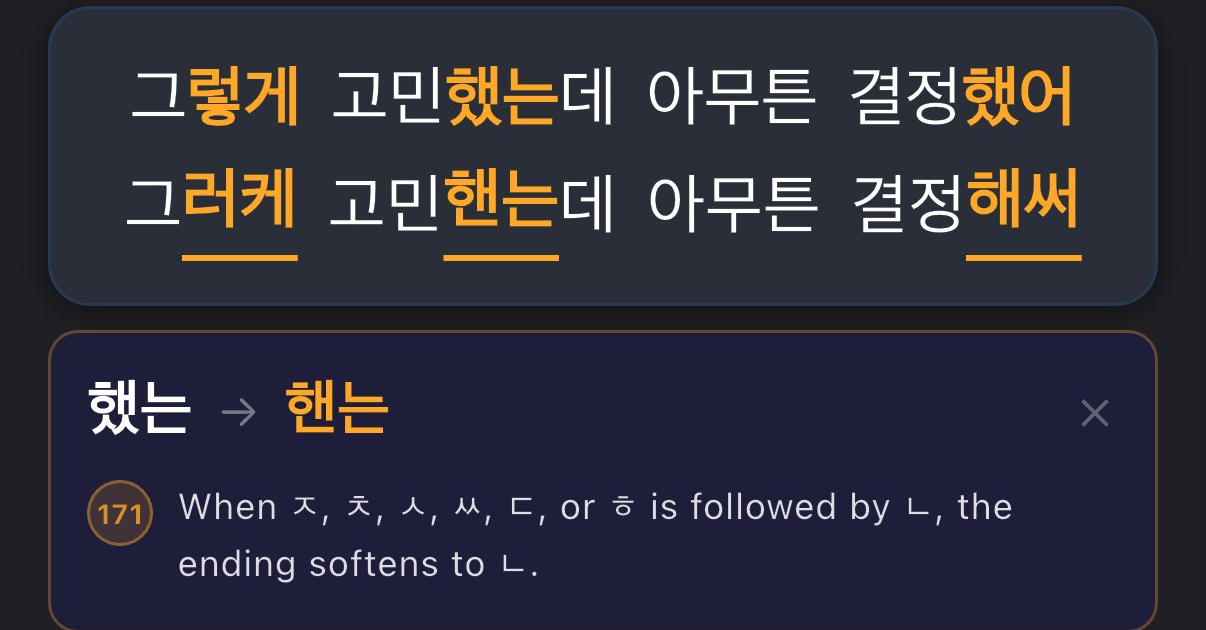
After you record a sentence, the system shows it both as written and as actually pronounced. Underlined syllables in the pronounced version mark places where a rule applied. Tap any underlined syllable to see which rule changed it and why.
Natively voiced syllables, side-by-side
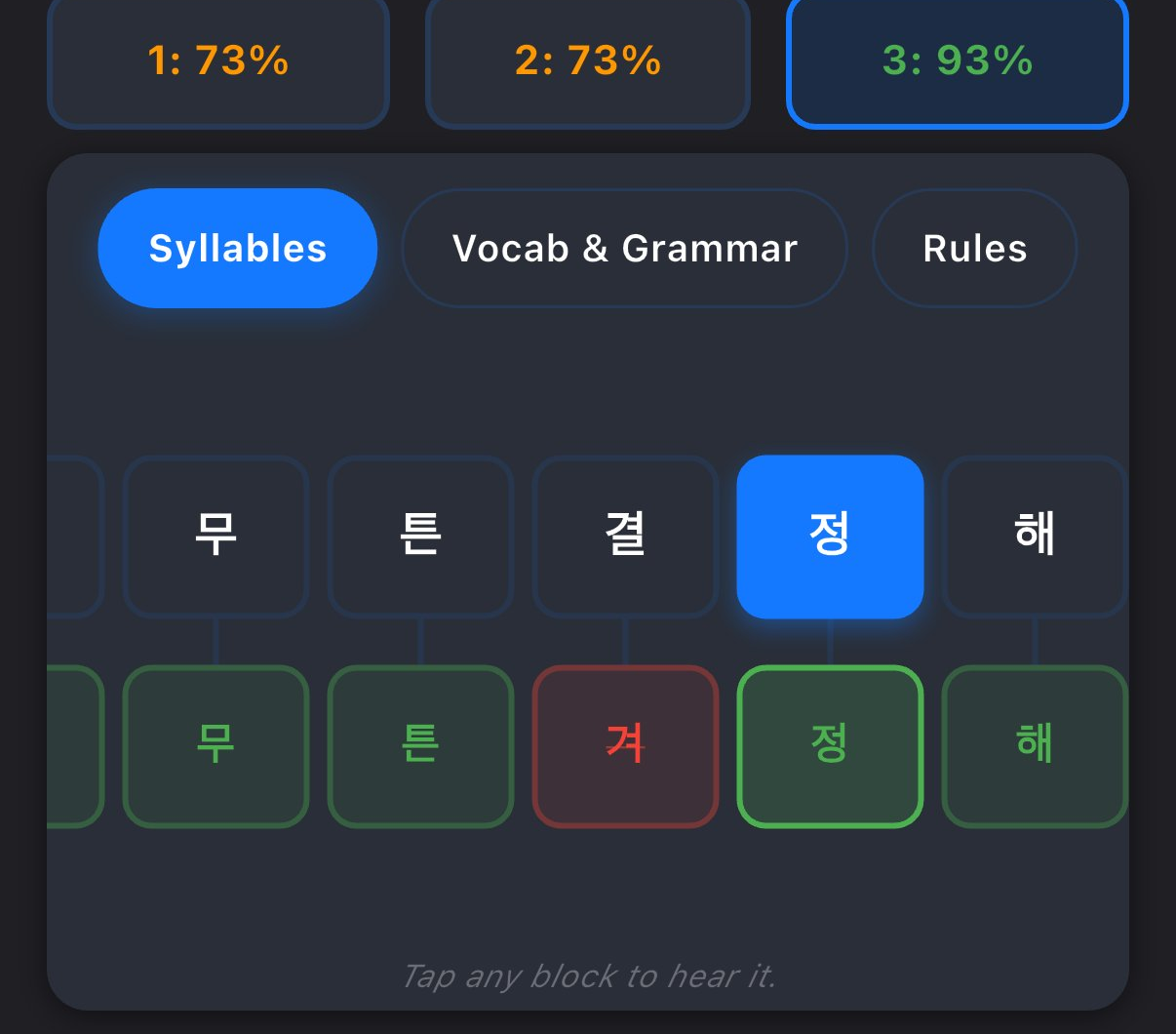
Below the sentence, you see what you should have said above what you actually produced. Syllables you got right are green. Syllables you got wrong are red.
For any syllable, you can tap to play a side-by-side comparison: your audio for that syllable, alongside a native Korean speaker pronouncing the same syllable. Not a TTS approximation. An actual recording. Forced alignment makes the comparison syllable-by-syllable, so you can hear exactly where your sound diverged from the native one.
It starts at 한글
None of this is limited to sentence practice. The same per-phoneme evaluation runs in a dedicated pronunciation track, where you can drill specific sounds and rules on their own instead of waiting for them to come up in a sentence.
It also runs from the very first lesson. When you're still learning 한글, most apps just play a sound and ask you to tap when you think you've got it. Flash Fluency evaluates each syllable you produce against a native recording, the same way it grades a full sentence. You find out whether your ㅓ actually sounds like ㅓ on day one, not three months in.